ICFP 2025 [icfp-2025]
- October 24, 2025
- Patrick Ferris
Two weeks ago I was fortunate enough to attend the International Conference on Functional Programming in Singapore. My first time in Asia and my second time at the conference, what follows are some thoughts and presentations I enjoyed whilst I was there.
I must thank my office mate (and friend!) Ryan Gibb for his camaraderie and sage advice: "the best track is hallway track". Not to mention all of his photos too. Thanks Ryan!
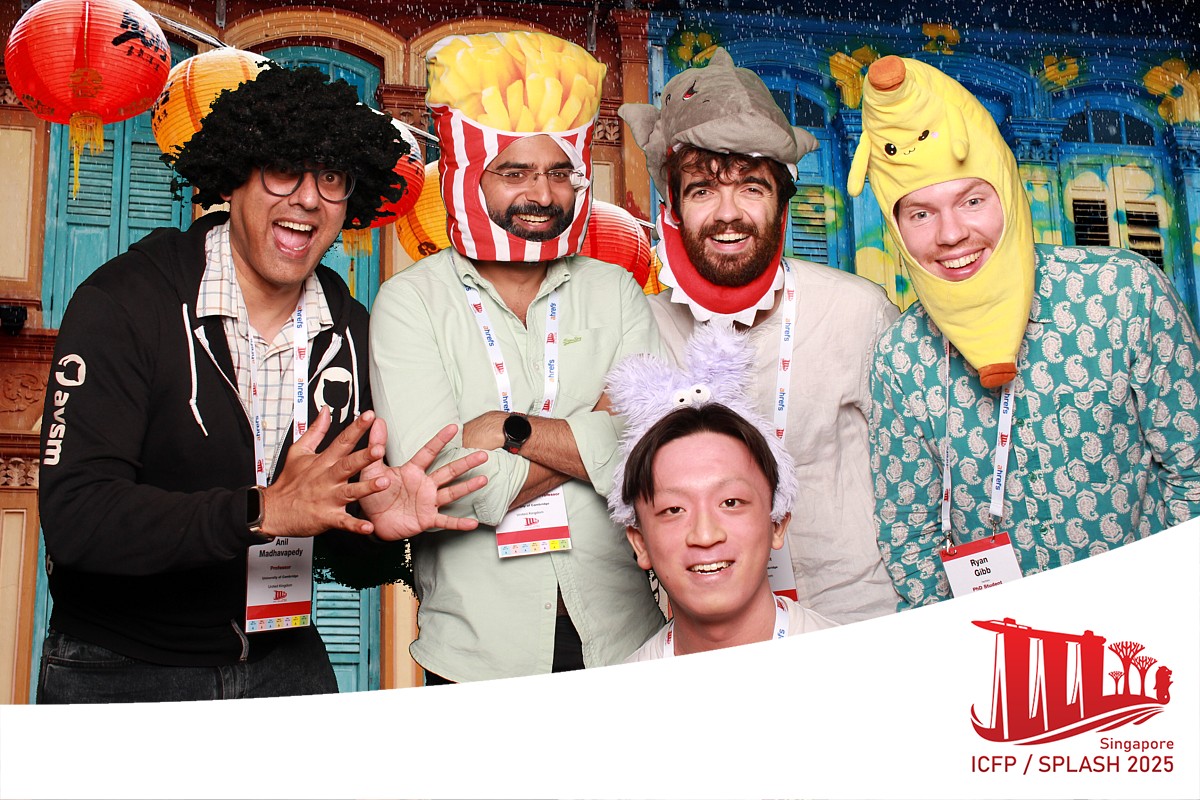
From right to left, top to bottom: Anil Madhavapeddy, Sadiq Jaffer, Patrick Ferris, Ryan Gibb and Roy Ang.
Random Hacking
- October 24, 2025
- Patrick Ferris
Below are just some of the pieces of random hacking I got up to whilst in Singapore.
OxCaml and Uring [oxcaml-and-uring]
- Patrick Ferris
Jane Street were a big presence at ICFP 2025, carting along with them a shiny new OCaml compiler: OxCaml. If have been playing around with OxCaml recently but nothing outside toplevels in Javascript. Until now!
After talking to David, I spent some time converting a small corner of the ocaml-uring library to use a part of OxCaml. In particular making the following change:
  module Heap = struct
    type ptr = int32#
    (* ... *)
  end

  type cqe = {
    user_data_id : Heap.ptr;
    res : int32#;
  }
The idea being that a completion queue entry (a notification that some operation has completed) could be fully represented using 64 bits (two 32-bit, unboxed values). You can see how this impacted the library! I'm not certain about this change (and I'm sure I did it wrong) but it was nice to realise OxCaml gives you this kind of control. However, I am worried about the ergonomics of manipulating values like int32# and the temptation to case it into an int (presumably losing a good portion of the value of having an unboxed value in the first place).
Bibtex Parser
- October 24, 2025
- Patrick Ferris
On the flight over to Singapore, I started to write a post for this website. Some readers may remember that I use forester after a preprocessing step via graft to build this site. Part of that preprocessing consumes bibtex files and outputs forester trees. For the initial graft release I used the excellent Talaria Bibtex library. Unfortunately, it presented a pretty confusing API that, whilst nicely typed, felt a little cumbersome to use. Additionally, it was too specific in what it would accept as valid Bibtex. I wanted something that was a little more straight-forward to use (if a little fast-and-loose when it comes to types...). And so I built bib.
This was my first real attempt at using the Bytesrw library. I was happy with the results, although I did have to copy a substantial amount of code from other bytesrw-compatible libraries. I'd be happy to shift to this bytes-first world if it wasn't for the ever-present-in-my-mind issue of relocatable values in the OCaml heap!
Geocaml Libraries
- October 24, 2025
- Patrick Ferris
There has been some excellent outreachy work happening on the geocaml/ocaml-tiff library which is a potential Outreachy internship project for December 2025. More on this in a future post.
On the way back (and a little during the conference), I spent some time building an OCaml counterpart to geotessera, a library for working with Tessera. The library is not ready for people to use directly, but I was working on various constituent parts including:
Modern OCaml bindings to PROJ (a coordinate reference system projection library)
Coming soon... ocaml-geotessera
Talks
- October 24, 2025
- Patrick Ferris
Hazel of OCaml at TyDe
- October 24, 2025
- Patrick Ferris
The type-driven development (TyDe) workshop was held on the first day of ICFP at the NUS School of Computing. I find the workshop name to be a little misleading, but perhaps this comes from my engineering background. The talks focused a lot on type theory, presenting the formal mathematics of interesting type systems with less focus on why it might be useful to have such an exotic type system... but then again, that was the nature of the entire conference.
I presented a talk on hazel_of_ocaml. The slides are here, along with the extended abstract. My talk ended up focusing a lot on the pedagogical benefits of having a type system that helped explain the most important thing a type system does... catch type errors! This work represents a small piece of work inside Max Carroll's excellent part II project, which he presented at the HATRA workshop: Decomposable Type Highlighting for Bidirectional Type and Cast Systems.
Scientific Programming at PROPL
- October 24, 2025
- Patrick Ferris
I think it is important to be honest whenever you get a talk accepted that you otherwise feel should not have been. My talk "what we talk about when we talk about scientific programming" is one such talk. The slides are here. The talk itself was nothing to write home about, but I think there were a few nice ideas that came out of it and the conversations I had with fellow PROPL attenders.
TMF Data Discrepancies Redux
- October 24, 2025
- Patrick Ferris
On the eve of my talk, I decided to re-run some analysis I did a few years ago on the tropical moist forest dataset, knowing that since then a few more years had become available. After fighting with some bit-rot in the Google Earth Engine script I had used, the new results were not very uplifting.
| Land Use Class | Percent Change |
| Undisturbed | -2.9 |
| Degraded | -5.5 |
| Deforested | 8.6 |
| Regrowth | 0.5 |
| Water | 0.0 |
| Other | -0.6 |
The data in the table corresponds to the land use class values in Indonesia in the year 2008. The analysis computed the difference across each of the classes between the dataset released in 2021 and the dataset released in 2024. Most notably, the amount of deforested land has gone up by 8.6 percent!
As a somewhat tangential, though related, aside, I had the pleasure of talking to Sam Westrick, Seong-Heon Jung and Sundara Vishnu Satish of the ParCour research group. They were telling me about MaPLe, a programming language from the MLs built for parallelism. We discussed some ideas of using real-world, geospatial algorithms as benchmarks for MaPLe. Michael, if you got this far remind me to chat to you about this!
Shelter Reactions
- October 24, 2025
- Patrick Ferris
At the end of my talk, I briefly mentioned shelter. By far, this was the topic I got the most engagement on post-talk. During the conference, this was also true when people asked what I was working on. The tag line "a shell with undo" seemed to capture the attention of most people.
I'm feeling a renewed sense of interest in my own work thanks to that, even if the "research" contributions are not very apparent. However, I also had a good discussion with KC about the underlying MRDT in Shelter and how we might think about collaborating in the future on MRDT-related work.
Related to that, I managed to spend the evening in Chinatown with Roly Perera. Roly's work has focused on Fluid, a transparency-based programming language that allows authors to reveal their computation to their user. Excitingly, Roly presented a new text-based part of the language at PROPL. Our work is in the same universe, loosely orbiting some notion of reproducibility and explainability, but quite different in engineering work and how users might actually interact with our systems. I thoroughly enjoyed talking about solutions or research ideas that preserve existing workflows. Roly was great at pulling that out of the current work I have been doing.
Other Talks and Highlights
- October 24, 2025
- Patrick Ferris
I was a part of, often in a very small way, some other talks that were presented at ICFP including
Functional Networking for Docker, I encourage you to read Anil's notes on the topic. It is also worth mentioning Anil's post-posix talk (not unrelated to my Uring musings above).
Michael gave an excellent, very live, talk about Yirgacheffe at PROPL which I thoroughly enjoyed. I'm also excited about his recent developments which I'm sure you can clue into over on his blog.
Below is a non-exhaustive list of talks I enjoyed whilst at the conference. Some relevant, most of them not!
By far, one of the best talks was Polynomial-time Program Equivalence for Machine Knitting. I think the talk really nailed the "here's the idea, the details are in the paper"-presenting style as they described an "...algorithm that canonicalizes the algebraic representations of the topological semantics of machine knitting programs".
I attended most of the OxCaml tutorial presented by the incredibly friendly Gavin Gray.
Ryan's talk Spatial Programming for Environmental Monitoring at PROPL was excellent.
There's plenty more to talk about, and I'm sure my future posts will reference other parts of my experience at ICFP 2025. Thanks for reading, and if anybody is interested in any aspects of this do reach out!