OCaml Roundup: October 2025 [ocaml-roundup-october-2025]
- November 5, 2025
- Patrick Ferris
Welcome to a monthly roundup of OCaml-related open-source work I have been involved with. If you haven't already, a quick look at my ICFP roundup might be a good preface to what follows.
Outreachy December 2025
- November 5, 2025
- Patrick Ferris
The contribution period for this year's Outreachy round took place for most of the month of October. This year I am excited to be going back to a Geocaml project, working primarily to add writing capabilities to ocaml-tiff.
As per usual, I have been extremely pleased with the level of interest in the various OCaml projects being offered. Whilst we are still deliberating on our choices for interns this year, I won't say much more on the contributions, but if you want to get involved please do reach out! OCaml is a great language for geospatial work, striking a balance between reasonable performance for numerical code and also a rich type system for expressing complicated geospatial data-structures.
Ppxlib and the Future of Compiler Support
- November 5, 2025
- Patrick Ferris
Nathan has put a tremendous amount of effort into laying a roadmap this month for how ppxlib, going forward, will support future compilers. This is in response to the calamity that was bumping the internal AST to 5.2, and whilst I think we are adding a good deal more complexity, it will hopefully keep the ppx universe on an even keel for longer periods of time.
The first substantial PR for this modern world of ppxlib is in review!
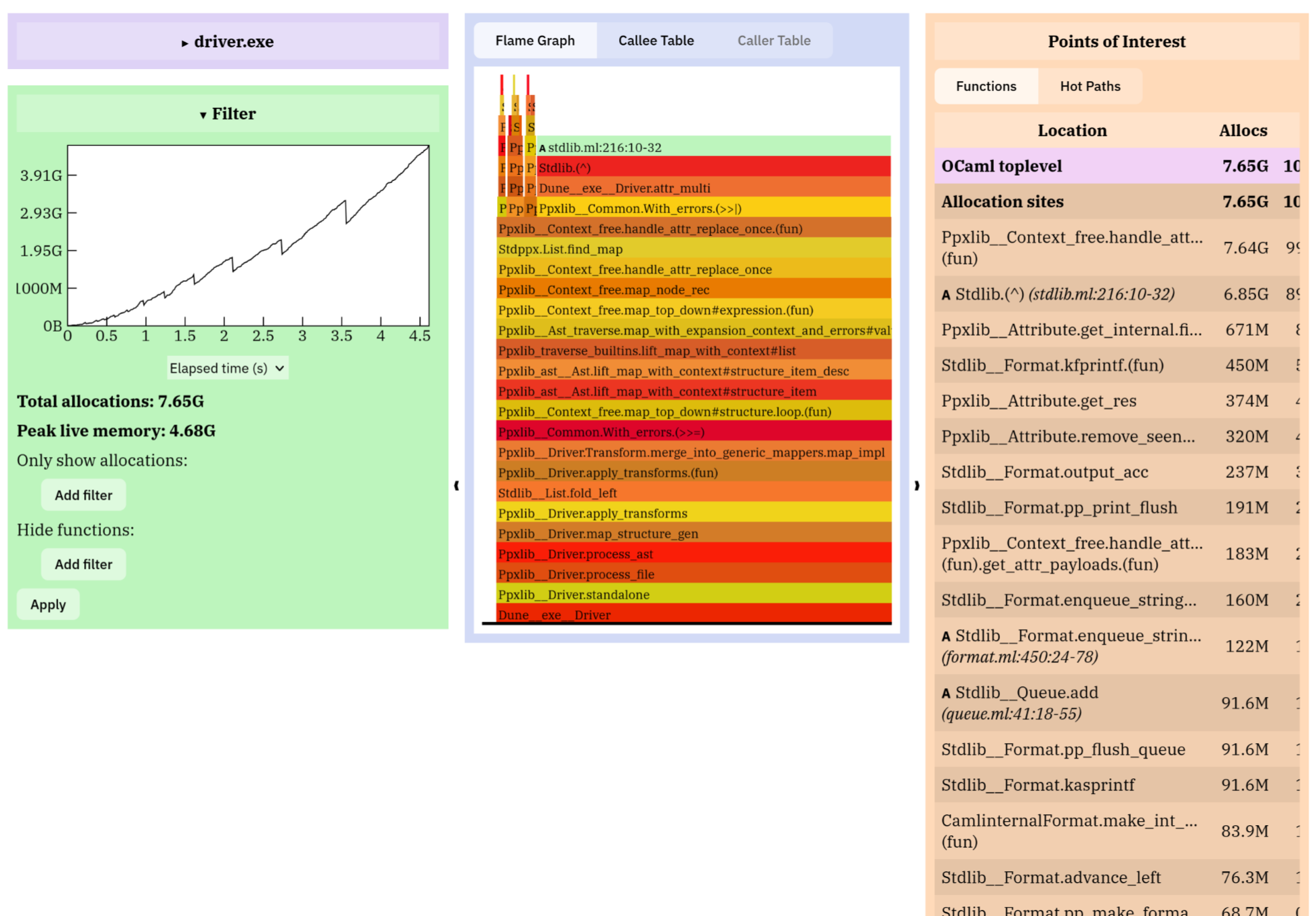
Aside from that I also debugged an issue that lead to ppxlib OOM-ing machines... of course, any recursive fold-like loop where the accumulator keeps growing is likely to do that! It was nice to be able to crack out memtrace to be able to hunt it down:
Incremental Directory Reading for Eio
- November 5, 2025
- Patrick Ferris
A common tasks for many a CLI tool is to scan a directory of files, filter out the ones you are looking for and apply some transformation to said files. In fact, that is what Graft and Forester both do! A standard approach to this involves a recursive dance of readdir and stat, the former lists the entries in a directory whilst the latter lets you know what kind of file is at a particular path (e.g. symbolic link, directory etc.). This has a few downsides:
We're making two systems calls (pretty much one of the most expensive things your program can do).
If a directory contains thousands of files, we end up allocating a big list of strings after returning from
readdir.
On Linux, we can get around most of that with getdents64(2) which allows us to incrementally read a directory. Whatsomore, this system call also returns the file type so there's no need to do an extra stat!
I prototyped an implementation of this called Eio.Path.walk which looks like:
val walk : _ t -> ((File.Stat.kind * string) Seq.t -> 'a) -> 'a
(** [walk t] traverses the directory [t] producing a sequence of results.*)
We effectively halve the number of system calls. In a benchmark that traverse deeply-nested directories with plenty of files, a full traversal whent from 1.46s to 110ms. I have since rejigged the implementation to automatically recurse for the user into subdirectories (not that the signature is unchanged) which does make it tricky to control the number of open file descriptors compared to if the user were in control.
OxCaml Experiments [icfp-oxcaml-uring]
- November 5, 2025
- Patrick Ferris
I have included here a transclusion from my ICFP post about an experiment using unboxed 32-bit integers in OCaml's Uring library.
OxCaml and Uring [oxcaml-and-uring]
- Patrick Ferris
Jane Street were a big presence at ICFP 2025, carting along with them a shiny new OCaml compiler: OxCaml. If have been playing around with OxCaml recently but nothing outside toplevels in Javascript. Until now!
After talking to David, I spent some time converting a small corner of the ocaml-uring library to use a part of OxCaml. In particular making the following change:
  module Heap = struct
    type ptr = int32#
    (* ... *)
  end

  type cqe = {
    user_data_id : Heap.ptr;
    res : int32#;
  }
The idea being that a completion queue entry (a notification that some operation has completed) could be fully represented using 64 bits (two 32-bit, unboxed values). You can see how this impacted the library! I'm not certain about this change (and I'm sure I did it wrong) but it was nice to realise OxCaml gives you this kind of control. However, I am worried about the ergonomics of manipulating values like int32# and the temptation to case it into an int (presumably losing a good portion of the value of having an unboxed value in the first place).
x-ocaml with OxCaml
- November 5, 2025
- Patrick Ferris
I sent a few PRs to the OxCaml repository to get the toplevel working again and lucky the underlying culprit for why patches were disappearing was found. Watch this space for a new toplevel in the browser soon.
Geospatial OCaml
- November 5, 2025
- Patrick Ferris
In addition to the Outreachy work I mentioned above, I also found the time to keep the Geocaml project ticking along. A few projects saw some much-needed love including:
PROJ in OCaml
- November 5, 2025
- Patrick Ferris
A modernisation of the bindings to PROJ. PROJ is probably the most used and tested code for working with geospatial projections. Any time you get a sateillite image or a blob of GeoJSON, the geospatial data will normally have some coordinate reference system (CRS) with it detailing exactly what the numbers that tell you where something is mean. One of the most common being WGS84 (used by GPS and GeoJSON for example). Each CRS has its benefits and drawbacks, and often you will need to convert between them. That is what PROJ does.
WKT in OCaml
- November 5, 2025
- Patrick Ferris
Well-known Text (WKT) is a very simple encoding of geospatial objects and CRSs. For example, a polygon might look like:
Polygon ((10 10, 10 20, 20 20, 20 15, 10 10))
I used bytesrw to build a simple codec for the WKT format. It is probably about time to write the basic geospatial object library too, something similar to Rust's geo library.
Geotessera
- November 5, 2025
- Patrick Ferris
A lot of people in my group are excited about Tessera. They have made it easy to used the Tessera embeddings via a python library called geotessera. In true OCaml-at-heart spirit, I tried my hand at porting this library. I had a good deal of success, converting the data into Nx array, extracting the CRS and transform out of the GeoTIFF landmasks using ocaml-tiff, reading datasets using ocaml-geojson etc. This made me excited but also keen to improve the APIs of most of these libraries too.
I feel geocaml is at a critical mass where we can start to have this useful feedback loop for the libraries because there is enough functionality to actually use them!